
Encryption and Feminism: We’re Bringing The Conversation Online
A follow-up to our Mozilla Festival session on Encryption and Feminism: Reimagining Child Safety Without Surveillance.
By Audrey Hingle
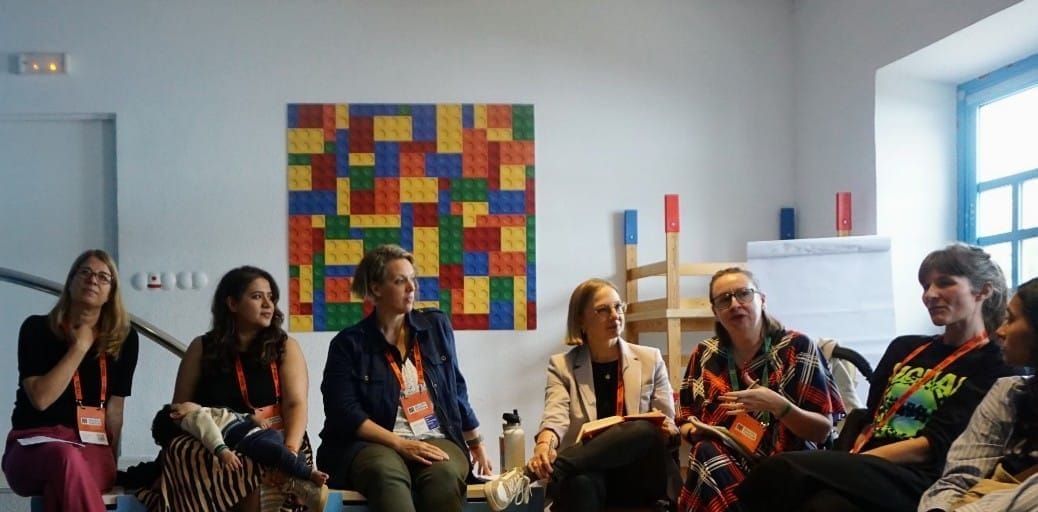
Our MozFest session on Encryption and Feminism: Reimagining Child Safety Without Surveillance was bigger than a one-hour festival slot could contain. The room filled fast, people were turned away at the door, and the Q&A could have gone on twice as long. Many attendees told us afterwards that this is the conversation they’ve been waiting to have. That feminist perspectives on encryption aren’t just welcome, they’re needed. So we’re opening the circle wider and taking it online so more people can join in.
In the room, we heard reflections that reminded us why this work matters. In feedback forms, attendees told us encryption isn’t only a security feature, it’s “part of upholding the rights of kids and survivors too, now let’s prove that to the rest of the world!” Another participant said they left ready to “be a champion of encryption to protect all.” Someone else named what many feel: “More feminist spaces are needed!”
It quickly became clear that this work is collective. It’s about shifting assumptions, building new narratives, and demanding technology that does not treat privacy as optional or as something only privacy hardliners or cryptography experts care about. Privacy is safety, dignity, and a precondition for seeking help. It is necessary to explore identity, form relationships, and grow up. Privacy is a human right.
We also heard calls for clarity and practicality: to reduce jargon, show people what encryption actually does, and push for privacy-preserving features more generally like screenshot protection and sender-controlled forwarding.
Participants also reminded us that encryption must account for disparity and intersectionality. Surveillance is not experienced equally. Some communities never get to “opt in” or consent at all. Feminist principles for encryption must reflect that reality.
And importantly, we heard gratitude for the tone of the session: open, candid, grounded, and not afraid to ask hard questions. “Normalize the ability to have tricky conversations in movement spaces,” someone wrote. We agree. These conversations shouldn’t only happen at conferences, they should live inside policy rooms, product roadmaps, activist communities, parenting forums, classrooms.
So let’s keep going.
New Virtual Session: Encryption and Feminism: Reimagining Child Safety Without Surveillance
🗓️ Feb 10, 4PM GMT, Online
Whether you joined us at MozFest, could't make it to Barcelona, or were one of the many who could not get into the room, this session is for you. We are running the event again online so more people can experience the conversation in full. We will revisit the discussion, share insights from the panel, and walk through emerging Feminist Encryption Principles, including the ideas and questions raised by participants.
Speakers will include Chayn’s Hera Hussain, Superbloom’s Georgia Bullen, Courage Everywhere’s Lucy Purdon, UNICEF’s Gerda Binder, and IX’s Mallory Knodel, Ramma Shahid Cheema and Audrey Hingle.
Help us grow this conversation. Share it with friends and colleagues who imagine a future where children are protected without surveillance and where privacy is not a privilege, but a right.
We hope you’ll join us!
Related: If you care about privacy-preserving messaging apps, Phoenix R&D is inviting feedback through a short survey asking for input on what features matter most for those in at-risk contexts.
New Book! Hidden Influences: How algorithmic recommenders shape our lives
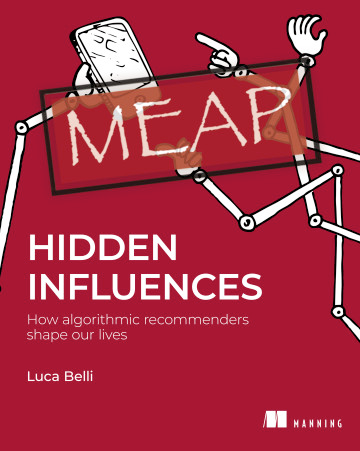
New book from IX client Dr. Luca Belli looks at how recommender systems function, how they are measured, and why accountability remains difficult. Luca draws on his experience co-founding Twitter’s ML Ethics, Transparency and Accountability work, contributing to standards at NIST, and advising the European Commission on recommender transparency.
Now available via MEAP on Manning. Readers can access draft chapters as they are released, share feedback directly, and receive the final version when complete. Suitable for researchers, policy teams, engineers, and anyone involved in governance or evaluation of large-scale recommendation systems. It is also written for general readers, with no advanced technical knowledge required, so when you're done with it, hand it to a curious family member who wants to understand how algorithms decide what they see.
Support the Internet Exchange
If you find our emails useful, consider becoming a paid subscriber! You'll get access to our members-only Signal community where we share ideas, discuss upcoming topics, and exchange links. Paid subscribers can also leave comments on posts and enjoy a warm, fuzzy feeling.
Not ready for a long-term commitment? You can always leave us a tip.
This Week's Links
Open Social Web
- Last week’s Franco-German Summit on European Digital Sovereignty set the stage for Eurosky, part of the Free Our Feeds initiative, which is building public-interest social media infrastructure on the Bluesky-backed ATProtocol to reduce Europe’s tech dependencies and create real alternatives to today’s centralized platforms. https://openfuture.eu/blog/eurosky-dawns-building-infrastructure-for-sovereign-social-media
Internet Governance
- The Seoul Statement is a joint declaration released at the International AI Standards Summit issued by the three major international standards bodies: ISO, IEC, and ITU. It outlines their shared commitments for developing inclusive, human-rights-aware, globally interoperable standards for AI. https://www.aistandardssummit.org/event/354f4a77-ee25-47e3-8e84-291a55519c0c/seoul-statement
- At the November 2025 TPAC event, François Daoust presented the Process 2025 which simplifies W3C’s standardization by removing the Proposed Recommendation stage. https://www.youtube.com/watch?v=KtXCtlAp9OU
- In the new policy paper The Algorithmic Hand, Tiago C. Peixoto asks whether AI-enabled deliberation can finally break democracy’s centuries-long cycle of technological hype and disappointment. https://www.linkedin.com/posts/tcpeixoto_the-algorithmic-hand-activity-7399792894418591744-3iW-/?rcm=ACoAACWJ_HIBp2ruf2wVpyUwySkAKakbPfg5KLw
- Google has updated Android’s Quick Share feature to support Apple’s AirDrop, which allows users of Apple devices to share files directly using a local peer-to-peer Wi-Fi connection. https://arstechnica.com/gadgets/2025/11/the-eu-made-apple-adopt-new-wi-fi-standards-and-now-android-can-support-airdrop
- Watch the recording of Audrey Tang at Stockholm Center for Global Asia for a public talk on how AI can strengthen democracy rather than undermine it. https://www.su.se/english/calendar/ai-democracy-and-plurality-in-a-time-of-polarisation-meet-the-2025-right-livelihood-laureate-1.862639
- New European antitrust investigation will examine whether Meta’s new policy on allowing AI providers’ access to WhatsApp may breach EU competition rules. https://www.cnbc.com/2025/12/04/meta-faces-europe-antitrust-investigation-over-whatsapp-ai-rollout.html
Digital Rights
- Add Surveillance News to your RSS reader to get the latest about state surveillance and threats facing social movements. https://activistchecklist.org/news
- Digital Freedom Fund highlights 13 new strategic litigation grants across Europe, with over €5 million awarded since 2018. Their next grant call is now open for organizations preparing to advance digital rights. https://digitalfreedomfund.org/digital-freedom-fund-winter-2025-2026-update-on-new-grants
- SFLC.in has been honored with the Electronic Frontier Foundation (EFF) Award 2025 for its outstanding work in defending digital freedoms in India. https://sflc.in/sflc-in-wins-the-eff-award-2025
Technology for Society
- We need a new generation of tech workers, says Lauren Chambers, Ph.D. candidate at the UC Berkeley School of Information. Workers she calls advocacy technologists who support the public sector and work in mission-driven, advocacy-oriented organizations. https://localnewsmatters.org/2025/11/30/beyond-big-tech-why-advocacy-technology-will-be-the-next-hot-career-in-ai-driven-world
- In the new report Bubble or Nothing, Advait Arun examines whether the current AI-driven data center boom is economically sustainable—or whether it’s vulnerable to collapse if the tech sector cools. https://publicenterprise.org/report/bubble-or-nothing
- Slop Evader by artist and researcher Tega Brain is fighting the internet’s enshittification by letting you surf the web like it’s 2022. https://www.404media.co/slop-evader-browser-extension-pre-generative-ai-search-filter
- In the latest episode of Occupied Tech, Tech For Palestine’s Paul Biggar is joined by Adil Abbuthalha, entrepreneur and creator of BoyCat — an innovative app empowering consumers to make ethical shopping choices and support the boycott movement against Israel. https://www.youtube.com/watch?v=2MJ1CyJKTXg
- Three years in, GDIP shows how feminist, community-led leadership can move the needle on global digital inclusion. https://globaldigitalinclusion.org/2025/12/02/three-years-of-gdip-feminist-leadership-global-momentum-and-the-urgent-work-ahead
- Tramas is a research-action project of theCoalición Feminista Decolonial por la Justicia Digital y Ambiental. Through cases and testimonies of resistance in several Latin American countries, they seek to unravel the complexity of contemporary digital extractivism processes. https://tramas.digital
Privacy and Security
- Kohler’s “end-to-end encryption” toilet cam isn’t actually end-to-end encrypted, which is… a bit shit. https://varlogsimon.leaflet.pub/3m6zrw6k2bs2p
- Half of the US now requires age verification to watch porn or access “harmful” content. Digital rights advocates are pushing back against legislation they say will make the internet less safe. https://www.wired.com/story/age-verification-is-sweeping-the-us-activists-are-fighting-back
- IAPP gives a policy-neutral explantion of how age assurance tools are used to verify or estimate a user’s age online, outlining approaches from simple self-declaration to ID checks and biometric age estimation. https://iapp.org/news/a/mind-the-gap-understanding-age-verification-and-assurance
Upcoming Events
- Briefing and Q&A on Enfironmental Impacts of AI from the Green Web Foundation. December 4, 4pm CET. Online. https://www.thegreenwebfoundation.org/services/ai-briefing
Careers and Funding Opportunities
United States
- OpenAI: AI Social Risk Analyst. San Francisco, CA. https://openai.com/careers/ai-social-risk-analyst-san-francisco
- Google DeepMind: Senior Technical Program Manager, AI Safety. Mountain View, CA. Apply by December 5. https://job-boards.greenhouse.io/deepmind/jobs/7409443
- Linktree: Head of Trust and & Safety Operations. Los Angeles or San Francisco, CA. https://jobs.gem.com/linktree/am9icG9zdDpX4_rOOLHEaqGlLPcdrTDz
- Aspen Institute, Senior Director, Cybersecurity Programs. Washington, DC. https://www.aspeninstitute.org/about/our-careers/career-opportunities/?jobId=8A47E5F6-ADB3-076C-13DC-DEA5363BBE0E
- Federation of American Scientists (FAS). Washington, DC.
- Director of Emerging Tech Workforce and Inclusive Growth Fellow https://fas.org/career/director-of-emerging-tech-workforce-and-inclusive-growth-fellow
- AI/ML Engineering Director Fellow https://fas.org/career/ai-ml-engineering-director-fellow
- Senior Manager, AI Safety and Security Policy https://fas.org/career/senior-manager-ai-safety-and-security-policy
- Senior Advisor, Artificial Intelligence & Global Risk https://fas.org/career/senior-advisor-artificial-intelligence-global-risk
- Stripe: Industry Strategist - Public Sector. Chicago, IL. https://stripe.com/jobs/listing/industry-strategist-public-sector/7385940
- The Berkman Klein Center for Internet & Society at Harvard University: Open Call for Fellowship Applications. Cambridge, MA. https://cyber.harvard.edu/page/open-call-fellowship-applications-2026-and-2026-2027
- Tech:NYC: Program Coordinator, Decoded Futures. New York, NY. https://www.technyc.org/work-with-us
- Microsoft: PostDoc Researcher-FATE (Fairness, Accountability, Transparency, and Ethics in AI-Microsoft Research. New York, NY. https://apply.careers.microsoft.com/careers/job?pid=1970393556626636
- Tech Policy Press: Assistant Editor. Remote US. https://jobs.gusto.com/postings/tech-policy-press-assistant-editor-35c37eba-5114-4e1e-bf6b-6322bcdf0b1d
- Tech Justice Law Project (TJLP): Operations Manager; Director. Remote US. https://techjusticelaw.org/wp-content/uploads/2025/11/Operations-Manager_Updated-Nov.-26.pdf
- Reddit: Trust & Safety Communications Manager. Remote, US. https://job-boards.greenhouse.io/reddit/jobs/7423921
Global
- Endless Access. Abu Dhabi, UAE.
- VP of Product, Community Platform - UAE. https://endlessaccess.bamboohr.com/careers/30?source=aWQ9MTA%3D
- Chief Growth Officer. https://endlessaccess.bamboohr.com/careers/29?source=aWQ9MTA%3D
- Digital Freedom Fund: Call for Applications. Due by February 2026. Remote Europe. https://digitalfreedomfund.org/digital-freedom-fund-winter-2025-2026-update-on-new-grants
- Internet Society: Pulse Research Fellowship and Mentorship. Closes December 23. Remote. https://pulse.internetsociety.org/fellowship
- May First: Technical Support Advocate. Remote. https://outreach.mayfirst.org/civicrm/mailing/view?reset=1&id=1544&cid=39715&cs=53c1d8b465c15f799235d982645e2dee_1764603233_168
What did we miss? Please send us a reply or write to editor@exchangepoint.tech.


Comments ()