What It Means to Lose Autistici/Inventati
A terrorism designation is forcing Autistici/Inventati to shut down operations, and forcing its blogging platform NoBlogs off the internet.

By Anne Roth
Nineteen years ago, I started a blog to document our experience after my partner was falsely accused of terrorism. Now, a terrorism designation is about to force that blogging platform off of the internet. Sometime late in the summer of 2007 I was looking for a place where I could publish a pretty unusual story. My partner had been arrested early in the morning in our family’s apartment in the center of Berlin by special police forces. That was the moment when we found out that he was suspected of being the master mind of a terrorist organization. Anti-terror surveillance had been directed at him for a year, and also at me at times. (He’s not a terrorist and never was, he was released eventually after some weeks and the investigation was later dropped. That’s a story of its own.)
I wanted to write about what that feels like and what it entailed in our daily lives. I had heard about a still somewhat new phenomenon called ‘blogs,’ or web logs, that could be useful when you wanted to publish content without setting up a full-blown website. That was what I needed: to be able to publish without the headache of taking care of software updates, security, or domain registration.
I was a digital rights activist (which you can read about here) before this had happened, and wasn’t keen to create something that would subject my readers to any sort of tracking, be it commercial or otherwise. So I was very happy when I discovered a blog platform that was run by Autistici/Inventati (A/I), an Italian tech collective that promised not to allow any of that. As I write this their policy is still accessible at noblogs.org. It says:
“Those who gathered around this blogging platform of ours share our manifesto and broadly our aims: struggle for a world where fairness, equal rights and freedom are the corner stones of people’s life; fight back a society too interested in controlling us and in knowing who we are instead of what do we think or love/hate; resist to the widespread idea that any single moment of our life can be traded with money or economically valuable stuff.”
I had already known A/I for some years. I’d met some of their members in 2001 during the protests against the G8 summit in Genoa, Italy, at the independent media center where hundreds of activists came together to report about the protests, long before social media existed. Together we watched in horror as the police attacked a school across the street where many activists slept after the demonstrations.
A terrorist designation
For 25 years, A/I has given activists like me a place to share our thoughts, but now it is being treated as a threat. Noblogs.org might not be online anymore when you read this. On August 26 A/I sent out an announcement that the US government had declared them to be supporters of terrorism. According to a press release by the State Department. “Autistici/Inventati (A/I Collective) is an Italy-based extremist group that builds and operates the digital infrastructure for violent Antifa cells and other far-left militants across the world.” The collective quickly rejected the allegations and wrote that they “strongly affirm our dedication to providing a platform of tools for digital self-defense, addressing the need of free communication for activists and other individuals, groups and associations.”
Two days later, their domain autistici.org disappeared. At first it wasn’t clear what had happened, since no one had bothered to tell A/I about it. According to A/I’s press release, the decision to make the domain unreachable was made by Public Interest Registry (PIR), a non-profit created by the Internet Society (ISOC) to manage the .org domain and “serve the public interest online”. The Italian chapter of ISOC protested vehemently against this in an open letter addressing not only PIR and ISOC, but also to the Internet Corporation for Assigned Names and Numbers (ICANN) and its European section, European Regional At-Large Organization (EURALO). In the letter they describe that at the point of writing, no evidence existed that Autistici had engaged or supported terrorist activities. In the words of A/I: “the U.S. government has decided to apply an extra-judicial procedure that makes it impossible to appeal through a due process and that exposes both those who provide services to A/I and those who use A/I services within the U.S. to the risk of being designated as terrorists.”
ISOC Italy went on to say that their concern was the role of PIR:
“Dot org is not U.S. property nor a for-profit corporate undertaking, but rather a global, supranational resource vital to freedom of expression and association online. Its management must reflect this objective, as was understood when it was awarded in perpetuity to the Internet Society and its wholly-owned operational entity, Public Internet Registry. The stewards of dot org should strive to ensure that no government has control over the online presence of non-profits that do not belong to or operate within its jurisdiction, and more generally that no single government can decide who gets to keep or lose a dot org domain name anywhere in the world.”
And this should indeed be a concern of everyone in the wider internet governance community. If the .org domain registration is, in effect, subject to the arbitrary decisions of the US government, then we need to consider whether and how this can be changed.
Again a few days after the designation, A/I’s bank, the Italian Banca Etica, told the collective that it planned to close its account. Its PayPal account had already been shut down on the first day without any notice. The closing of bank accounts of organizations accused of terrorism or support of terrorism is not an uncommon measure. However, here, too, there was no legal procedure that forced the bank to close the account. Instead, when the US government. places an organization on a terrorism list this can mean there will be further sanctions. The bank decided to suspend A/I’s account out of fear of the possibility of those further sanctions. Since September 4, A/I has been unable to access its own funds, which were gathered through donations from its users.
A former director of Banca Etica, Alessandro Messina, commented: “It is plausible that many banks would choose to close A/I’s account. One would expect, however, something different from an organisation founded to promote ethical finance, when faced with a designation of such markedly political nature (..)”
Another two days later A/I announced it would completely shut down:
“Stay human” is not an empty phrase to us.
It means, above all, that we have a responsibility to protect our users, those who build the human networks we rely, and for the communities who flooded us with messages of support and solidarity.
We cannot engage in a fight or expose ourselves to manipulations that threaten the lives of these people and their loved ones, leaving them at the mercy of autocrats, fascists and agencies that take extra-legal courses of action.”
An attack on political opponents
A shock went through the community of people that use A/I’s services. It’s a huge community. A/I has existed for 25 years and says that they hosted 20,000 blogs, 20,000 mail accounts, 5,000 mailing lists and 1,500 websites.
At this moment my blog is still online in read-only mode. I have lost access to the administration. Soon it will be gone, and with it nineteen years of my writings on digital policy and rights. The same is true for the many other blogs and websites from many countries, on a huge variety of topics including climate change, anti-militarization, Indigenous rights and healthcare reform as well as Antifa. When it goes, many, many links from websites around the internet will lead nowhere. Once more, I’ve become the collateral damage of a terrorism accusation. And so have many other voices.
Article 19 warned that “In addition to violating freedom of expression standards, this designation already spreads a chilling effect.” Twenty thousand blogs are going dark and there has been no outcry, because people are asking themselves whether it is wise to defend an organization the US has designated as terrorist. When authoritarian governments attack non-commercial, independent digital communication infrastructure like in this case, we can’t underestimate the impact. This time it was Italy, but next time might be closer to you. It is still much too quiet.
A political scientist by education, Anne Roth is senior advisor for digital policy for the Left Party in the German federal parliament. She co-founded the first interactive media activist website, Indymedia, in Germany in 2001 and has been involved with media and digital rights activism ever since. Anne was senior advisor for the Parliamentary Inquiry on Mass Surveillance of the German Bundestag 2014 – 2017. Conferences she spoke at include the Chaos Communication Congress, re:publica and the Computers, Freedom and Privacy Conference.
Related: The Rise Against Big Tech coalition pledges solidarity with Autistici/Inventati, after the US labeled it a terrorist group, and calls for more community-run internet infrastructure. https://howto.riseagainstbig.tech/t/we-remain-human-solidarity-with-autistici-inventati/254
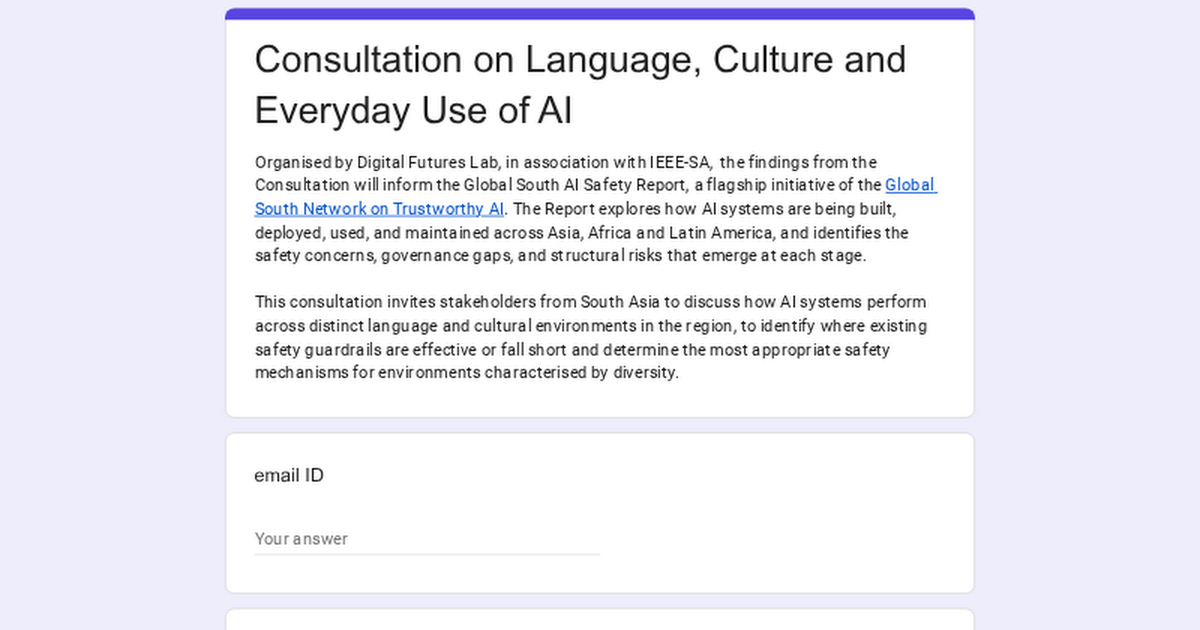
Consultation: Language, Culture and Everyday Use of AI – Perspectives from South Asia
Digital Futures Lab and the IEEE Standards Association invite researchers, developers and policymakers based in South Asia to a multistakeholder consultation on how AI systems perform across the region's diverse languages and cultures: where current safety guardrails work, where they fall short, and what safety mechanisms suit such diverse environments.
Held under the Global South Network on Trustworthy AI, the consultation will inform the Global South AI Safety Report, due for launch at the UN Global Dialogue on AI Governance in May 2027.

Date: 12 October 2026
Time: 11 am – 5 pm IST
Location: Bangalore, India, and online
Spots are limited, and registrants will be contacted to confirm participation. Please share with anyone in your network who may be interested.
Want to appear here? Sponsor a newsletter.
Support the Internet Exchange
If you find our emails useful, consider becoming a paid subscriber! You'll get access to our members-only Signal community where we share ideas, discuss upcoming topics, and exchange links. Paid subscribers can also leave comments on posts and enjoy a warm, fuzzy feeling.
Not ready for a long-term commitment? You can always leave us a tip.