What New Platforms Can Learn From Feminist Helplines
Nearly a decade of data from feminist helplines shows how big platforms have failed survivors of online abuse, and what the open social web can do better.

New social media platforms have the chance to build online spaces that are safer and more welcoming than the established platforms from the start, and they don’t have to start from scratch. Nearly a decade of data from feminist helplines, the frontline services that support survivors of technology-facilitated gender-based violence (TFGBV), shows how today’s platforms have failed women, children, gender minorities and other vulnerable communities for years through slow responses, rules blind to local context, and abuse amplified by new technologies like AI. Builders on the open social web have the opportunity to understand those harms and do better by design rather than as an afterthought.
The big social media companies have long promised robust safety systems and clear community guidelines. New research from the Digital Rights Foundation (DRF) and the Social Web Foundation, with the support of the Association for Progressive Communications, suggests those promises ring hollow. Survivors around the world describe experiencing harmful content that stays up far too long, reporting systems that are opaque and retraumatizing, and enforcement that is inconsistent or blind to cultural context.
In a 2025 global survey by Uplevyl, a female-forward technology platform, 66 percent of women said they had stepped away from social media because of harassment or safety concerns, and nearly half had left at least one platform for good. These aren’t isolated incidents. As the report puts it, they are “the digital extension of offline patriarchal structures.”
What follows draws on DRF’s findings, describing what feminist helplines are seeing on the ground, how platforms have responded (or failed to respond), and what builders on the open social web can learn from nearly a decade of data from feminist helplines.
Feminist helplines hold the receipts
Where platforms and governments have failed to offer real remedies, feminist helplines and grassroots digital safety groups have emerged as critical support structures for survivors of TFGBV. They support survivors directly, and they also act as observatories, gathering and publishing data on online abuse that is often unavailable elsewhere.
The scale of that record is striking. DRF’s own Digital Security Helpline in Pakistan has recorded over 25,000 complaints since 2016, including 3,012 in 2025 alone. Helplines such as Acoso Online in Chile, Luchadoras in Mexico and Internet Bolivia SOS have published their own maps of abuse trends. In 2024 the Digital Defenders Partnership launched the Feminist Helpline Index, a shared repository of helplines across 13 countries. Together, these make up a body of evidence that has not been researched at the scale of DRF’s latest report. It refers to helplines as “knowledge leaders,” and anyone designing a new platform should treat them that way.
What the receipts show: the harms
DRF’s research draws on two sources. The first is a survey of 14 helplines in 14 countries across Asia, Sub-Saharan Africa, Latin America, and the Middle East and North Africa, each chosen because it supports survivors directly and deals with platforms’ reporting and escalation systems. The second is a set of in-depth interviews with five helplines, which dig into the trends the survey surfaced. All 14 helplines handle non-consensual intimate image abuse, impersonation, blackmail and sextortion. Eleven now also deal with abuse created with generative AI.
The research shows abuse changing as fast as technology does. Three patterns stand out: image-based abuse, non-consensual AI-generated content, and sexual deepfakes aimed at politicians, creators and other women in public life.

Image-based abuse
Image-based abuse was the most common category of harm the research found, and it looks different depending on country and cultural context. It isn’t only about explicit images. Impersonation, covert filming, refusing to delete photos after a breakup, and sextortion (often starting from images shared in trust) all fall under it. What counts as harmful depends heavily on local context, so a photo that a platform may see as harmless because it does not violate their community guidelines can put a woman at serious risk in her community. This is something Chayn also found in their recent research on image-based abuse.
One recent trend in India, documented in the report, shows how this works. Perpetrators post secretly filmed footage of women going about everyday life, such as walking down the street, working in fields or shelling peas. The women are fully clothed, but the camera angles are invasive and the videos are often captioned with incest-themed keywords. This isn’t footage lifted from public videos. Someone is filming these women without their knowledge.
Sextortion is another frequent form of abuse. Four of the 14 helplines said it was the complaint they escalate most often, and victims frequently have little idea how to protect themselves. The Cyberclinic Helpline run by the Ghana Internet Safety Foundation describes partners who ask for explicit photos or videos during a relationship, then use them after a breakup to demand money or pressure the victim to come back.
Non-consensual AI-generated content
Eleven of the 14 helplines surveyed now handle generative AI abuse. AI makes abuse cheaper, faster and harder to trace. Nudify tools fabricate explicit images that often spread to porn sites, where they attach themselves to victims’ names in search results. Helplines often struggle to tell what’s AI-generated.
The forms this abuse takes vary by country and by cultural context. In India, Meri Trustline saw a large volume of AI “nudify” content in 2024. It also found AI-generated explicit songs using famous singers’ voices that led listeners to doxxed ex-girlfriends, and explicit frames spliced into women creators’ videos to slip past automated detection. In Indonesia, SAFEnet reports a rise in morphing cases alongside deepfakes, and DRF’s data from Pakistan shows AI-enabled image-based abuse among the growing harms. In Ecuador, Navegando Libres has had to adapt its services to AI-generated abuse. In Iraq, Tech4Peace got a deepfake of a hijabi politician taken down faster than Meta’s third-party fact-checkers could act.
Deepfake sexual content targeting women in public life
For women in public life, sexual deepfakes work as a political weapon. They are timed to elections and aimed at women whose visibility already makes them targets. Where social norms make sexual shame especially damaging, attacking women becomes a deliberate strategy.
DRF’s interviews found this pattern in Iraq, where AI-generated nude or near-nude images and videos of politicians, especially hijabi politicians, circulate at critical moments such as elections. Influential and political families are often attacked through the women in them, or through women who are public figures. Given local social norms, the report notes, this is often seen as “the most ‘effective’ strategy to threaten and silence dissent.”
Creators face a version of this too. Rati Foundation’s 2025 report on its Meri Trustline helpline in India describes coordinated, “networked” abuse that uses memes, edited content and voiceovers to ride viral trends across platforms. In most of the cases Rati documented, women creators found AI-generated copies of their own reels with explicit, sexualised frames inserted at regular intervals, posted by multiple accounts. Splicing explicit frames into otherwise ordinary videos helped the content evade automated detection. Escalation channels often still got it taken down, but Rati warns this is getting harder as AI tools spread.
How existing platforms failed
Ten of the 13 helplines that answered said platforms don’t respond quickly enough. Meta, which receives the most escalations, was the slowest, with waits of a week, ten days and sometimes a month. TikTok was faster, in one helpline’s experience taking content down within an hour.
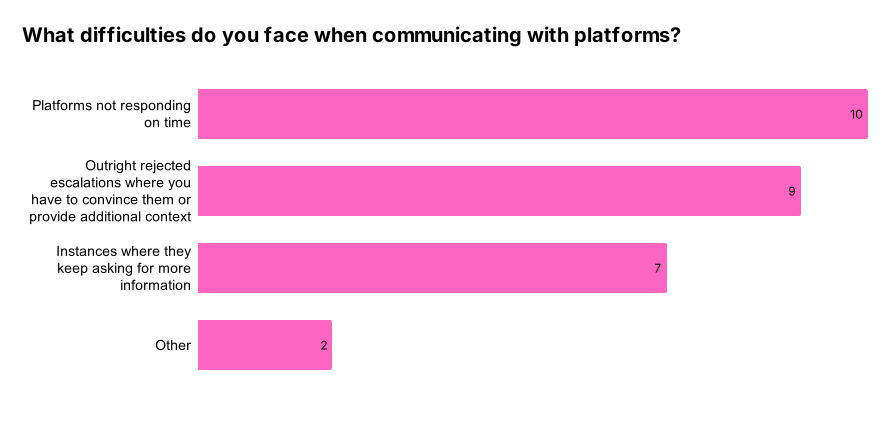
Speed isn’t the only problem. When the secretly filmed videos in India were reported to Meta for weeks through official escalation channels, Meta acted on individual accounts. Nothing was done about the trend itself, so similar content kept circulating. DRF’s 2024 helpline report records a similar case. A survivor repeatedly reported a profile to Meta that contained her images and personal details, and each time the platform found no violation. It ignored a cultural context in which that content could put her at serious risk.
Enforcement is also inconsistent. Facebook and Instagram topped the list of platforms where helplines see the most enforcement errors. Twelve of 13 helplines said they had resorted to personal contacts inside platforms to get cases resolved. As a helpline worker at Cyberclinic in Ghana pointed out, chasing cases over email or, more often, WhatsApp eats up time for teams juggling many cases a day. It also bypasses any official channel of liability, accountability or remedy. Safety, in other words, runs on personal favours.
Lessons for the Open Social Web
Feminist helplines offer a model of digital governance that is care-driven, community-rooted and survivor-led. Unlike mainstream platforms, with their centralized, top-down policymaking, decentralized networks promise community decision-making, federated servers run by their own communities, moderation rules suited to local context, and strong protections for users. But they still face problems of scale and have yet to seriously challenge the dominance of the big platforms.
None of the helplines reported major cases involving Mastodon or Bluesky, and some said there was very little awareness of these platforms in their communities. The report raises the possibility that community self-moderation, through Bluesky’s open approach to moderation or Mastodon’s ability to defederate servers, might one day reduce the need for outside helplines. But with so few users in the Global South, that idea can’t yet be tested.
The abuse documented in this research hasn’t reached these networks at scale yet. Helplines spot new forms of abuse that centralised platforms miss, and many already act as trusted flaggers, escalating harmful content as priority cases with an explanation of why it is dangerous in its local context. The report urges new platforms to build on this experience, with policies designed for women, minors and marginalized groups and sensitive to regional differences. And every helpline surveyed asked for transparency about how reports are escalated and prioritized, and how platforms decide what counts as harm.
Recommendations
- Build trusted partner channels into the network. On a federated network, a helpline can’t be expected to hold contacts on thousands of servers. Developers, server admins and moderation services should create shared, recognised routes for helplines to escalate cases across the network, and consult them regularly on policy and regional concerns.
- Treat response time and transparency as basic standards. This includes context and updates on how a case is progressing, and transparency in escalation methods, in prioritization mechanisms and in the categories used to decide what is or isn’t harmful content. Escalation training can also help helplines know exactly how to build a case that meets moderators’ needs.
- Address abuse at a trend or network level, not just individual accounts. Shared signals such as labels and blocklists can help patterns be recognized and addressed across servers. Most platforms focus primarily on posts and captions, but comment sections also generate significant hate speech, abuse and overall harm. Even when posts, images and videos are not violating in themselves, comments that encourage harm should be actioned, particularly when there are calls to violence and abuse.
- Take regional sensitivities into account. New and emerging platforms should take into account the findings and experiences of feminist digital security helplines, and incorporate policies that best serve users, particularly women, minors, and other vulnerable and marginalized groups. Local rules and community-run moderation make this possible on the Open Social Web. Hold active dialogues with helplines about what makes content from their region high-risk, and make moderation more inclusive of local languages and culture.
- Provide support on AI-generated content. Without further help from platforms, either through verification or watermarking, feminist helplines will continue to be stretched thin, and much AI-generated content that acts as TFGBV or disinformation will be left unchecked. Labels for AI-generated content and synthetic media should be prominent and easy for the average person to understand.
- Openly share guiding principles. Feminist platform accountability requires platforms to openly share their guiding principles, and to be open to changing them based on recommendations from experienced people in the field.
Platforms are still failing their users and leaving feminist helplines to secure remedy and recourse on survivors’ behalf. Those same helplines are now losing funding and slipping down donors’ priority lists. Anyone building the next generation of social media should recognise the essential work they do, and fund it. As the report concludes, the work of feminist helplines “signals the need and the possibility of building more equitable and humane digital futures.”
Try IX membership free for a month
Want to see what being an IX member is like? Until the end of 2026, you can try a paid subscription free for a month. You'll get access to our members-only Signal community, where readers swap ideas and news from across public interest technology. You'll also be able to comment on and reply to posts, and you'll get our weekly round-up of the best links from the field. Your support helps us keep sourcing, researching, writing and editing the IX. Claim your free month now!
Want to appear here? Sponsor a newsletter.
Support the Internet Exchange
If you find our emails useful, consider becoming a paid subscriber! You'll get access to our members-only Signal community where we share ideas, discuss upcoming topics, and exchange links. Paid subscribers can also leave comments on posts and enjoy a warm, fuzzy feeling. For a limited time, you can get a subscription free for one month! Claim yours.
Not ready for a long-term commitment? You can always leave us a tip.