What do cloud service companies disclose about their use of fossil fuels?
Green Web Foundation thinks not enough.

By Chris Adams
Major cloud providers (Google, Amazon, Microsoft) aren't publicly disclosing basic information about how their data centers are powered, even data they're already required to report to regulators.
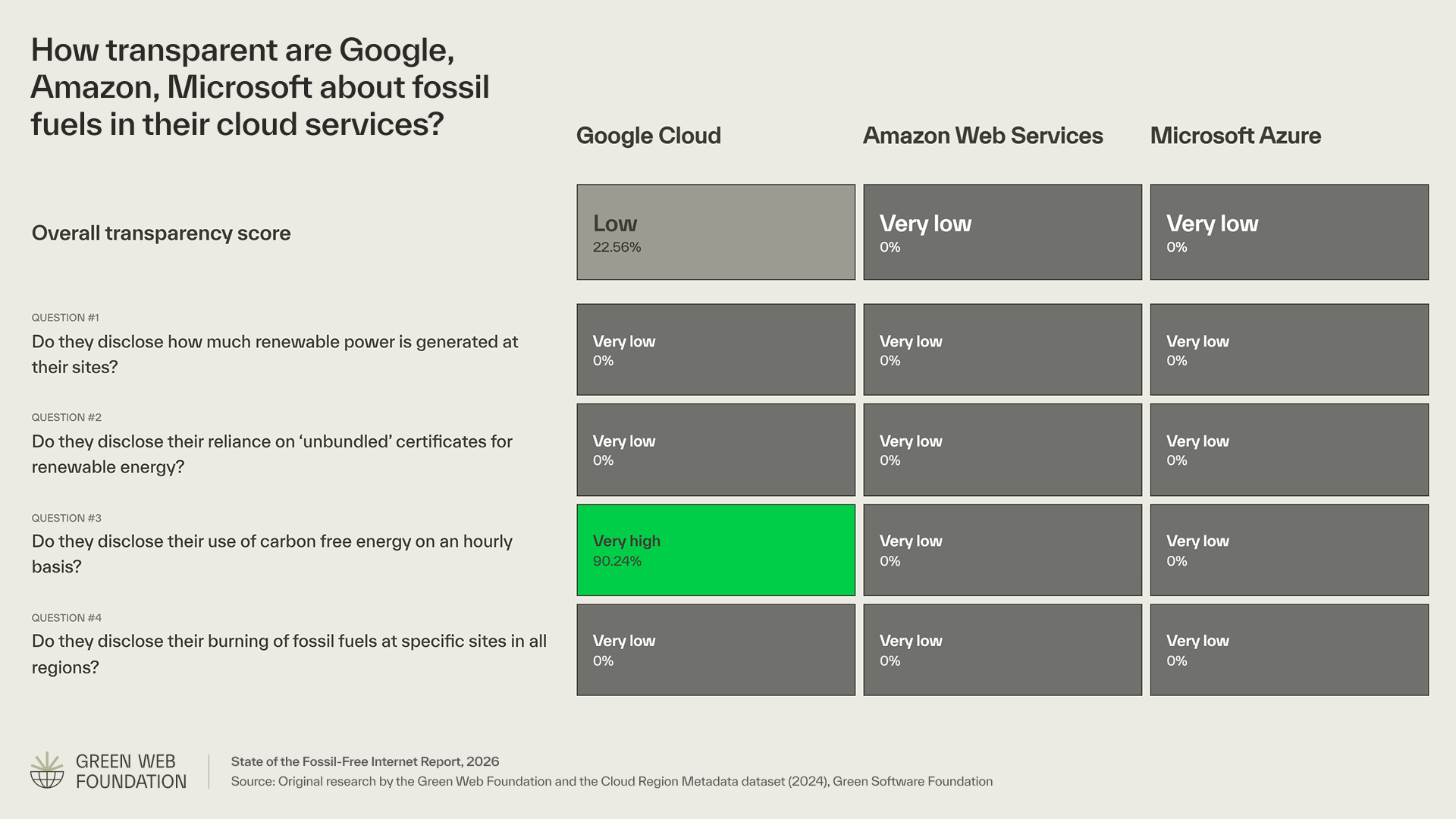
In our recent report, State of the Fossil-Free Internet 2026, we include a table with a transparency score based on four questions about company disclosures of how data centres are powered, checked against the information published on what is one of the more complete open datasets on the topic from a leading industry group dedicated to greener software solutions.
You can see this chart below, or in a larger version on our website:
Why do we look at these three firms?
When we think about the global buildout of gigantic datacentres changing the footprint of the internet, there are three companies, Alphabet, Amazon and Microsoft, who offer families of cloud services, under the names Google Cloud, Amazon Web Services, and Microsoft Azure respectively.
These historically have made up more than half of the hyperscale cloud market. When we look at the current, massive levels of investment in datacentre buildout globally, they also make up a disproportionately large share of the capital expenditure, which has doubled since the release of ChatGPT.
Why are they important for decarbonisation of the internet?
Since the boom in artificial intelligence, the total emissions of Alphabet, Amazon and Microsoft have been growing, but these companies have also consistently been the largest investors in clean energy in the corporate sector, with bold public announcements of net-zero targets. How they spend money on energy has a direct impact on how quickly the sector decarbonises.
Their structural importance and market dominance also now means that if you use any mainstream digital service in 2026, it’s likely that at least one of these cloud service providers is in its supply chain. Either you’re a direct customer of these companies, or one of your suppliers will be.
Faced with this, when we think about tracking progress towards a fossil-free internet, how these three companies disclose information is crucial to our understanding of what is happening across the internet’s infrastructure and in the software and apps we build and use worldwide.
What did we base our transparency score on?
The Green Software Foundation is an industry association composed of dozens of tech companies, institutions and non-profits working together to solve sustainability challenges and exchange information on how to build greener systems. We chose the Cloud Region Metadata dataset by the Real Time Cloud Working Group of the Green Software Foundation as the basis for the transparency score in our report. The dataset was developed with early involvement from cloud service providers, and there was a rigorous process for collecting the data over the last two years, which we have actively participated in ourselves.
We chose this dataset because it provides information at the cloud region level, matching how customers select deployment locations in their dashboards, so companies can choose regions powered by renewable energy. The dataset is public and openly licensed (permissive MIT license), meaning it can be freely integrated into commercial and non-commercial products. Its columns are clearly documented using existing standards and reporting requirements, such as Europe's Energy Efficiency Directive. The dataset is also on a standards track to become an internationally recognized standard for cloud region reporting, stewarded by the Green Software Foundation, which established the Software Carbon Intensity ISO standard.
While there remain data gaps, this is currently one of the most complete datasets in the public domain that we can refer to, and the governance process is clearer than with most other datasets we have seen. We looked at the most recent available data at the time, which was for 2024.
What did we look for in the dataset?
For the State of the Fossil Free Internet, we wanted to track progress towards the decarbonisation of the internet. We wanted to document how the trajectory has changed, compared to an earlier era of gradual decarbonisation that we saw in the late 2010s and early 2020s. However, we don’t have access to granular data in a standardised format that enables us to do this type of comparison—even for the three biggest companies in the cloud sector. Based on the (usually empty) data fields in this public dataset, we developed four questions (in plain language) that get to the heart of what we most need for transparency.
These questions are:
- Do they disclose how much renewable power is generated at their sites?
- Do they disclose their reliance on ‘unbundled’ certificates for renewable energy?
- Do they disclose their use of carbon free energy on an hourly basis?
- Do they disclose their burning of fossil fuels at specific sites in all regions?
Let’s look at each question and what data is out there.
1. Do they disclose how much renewable power is generated at their sites?
When you say a datacentre runs on clean, green or renewable energy, a lot of the time it conjures images of a building with solar panels on the roof, or wind turbines sited right next to the facility containing the servers. Large companies do very little to dispel this image—just see the example from Google’s datacentre site below.
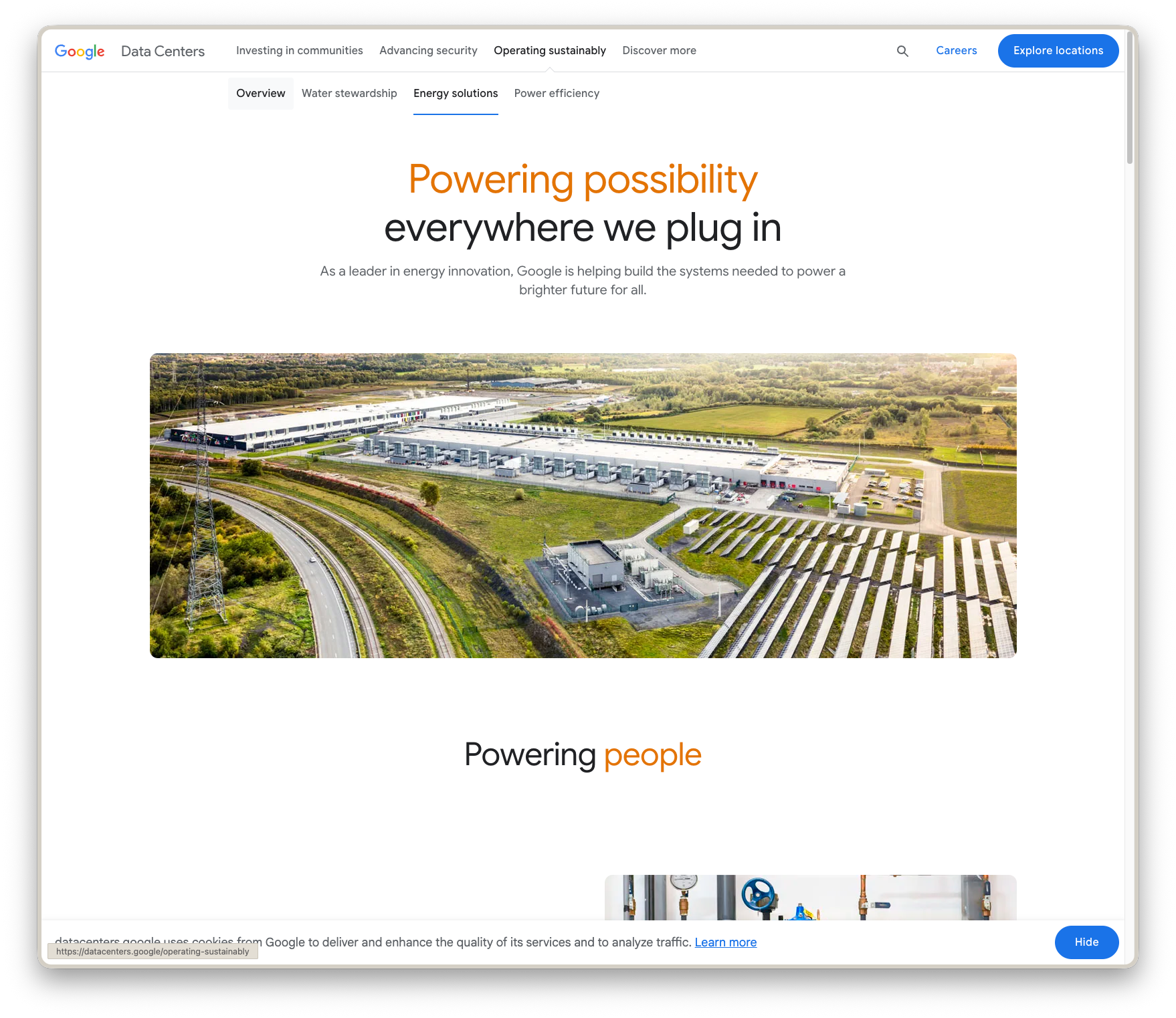
However, the reality is that datacenters' energy density requires far more generation than can be produced onsite. A 100 MW datacenter would need at least 400 acres of solar panels, far exceeding what's visible at these facilities.
So our first question is whether companies transparently reported how much renewable energy is actually generated onsite versus sourced through other means. Using the dataset, we found that while European laws (the Energy Efficiency Directive and Delegated Regulation 2024/1364) require companies to report this figure at the datacenter level, meaning the data exists and is being disclosed to regulators, none of the big three cloud providers publicly disclosed this information at the cloud region level.
2. Do they disclose their reliance on ‘unbundled’ certificates for renewable energy?
If datacentres aren’t really powered by onsite green energy that much, what is the next most common way to power them?
Rather than generating renewable energy onsite, companies often take a cheaper shortcut: purchasing electricity from the grid and buying unbundled annual clean energy certificates to claim renewable consumption. While accepted under standards like the GHG Protocol, a widely used carbon accounting framework, it has credibility issues.
Many people want to know whether green energy claims are based on actual onsite generation or just purchased certificates. Certificate-based claims are arguably less credible than onsite generation or long-term power purchase agreements which fund new renewable infrastructure like wind farms.
Data from the European Commission shows that certificates, called Guarantees of Origin in Europe, are far more commonly used than either onsite generation or PPAs. The Real Time Cloud dataset includes a column for certificate-based consumption, and again, in Europe companies have to disclose this at a datacentre level under the same laws as they do for onsite generation. So, the data does exist to disclose this, and will have already been collected. But so far, no companies have publicly disclosed this at a region level in the Real Time Cloud dataset.
3. Do they disclose their use of carbon free energy on an hourly basis?
In response to the problems associated with ‘unbundled’ annual certificates, a new, more credible way to claim clean energy generation is based around hourly clean energy certificates.
Under an hourly scheme, a claim to be using clean energy at night would have to be backed by a certificate for clean energy that was either generated at night, or generated during the day then stored in a battery until the battery was discharged at night.
This results in a more credible claim to use clean energy than before, because it more accurately represents what is happening on the electricity grids. This hourly basis will likely become the main standard for tracking the ‘greenness’ of energy in the GHG Protocol’s Scope 2 guidance. We will ourselves also update our verification process for the Green Web Check directory largely based on the expected shift to this hourly approach.
Both Microsoft and Google made public commitments in 2020 to transition to running entirely on clean energy backed by hourly certificates by 2030. This is a column in the dataset, under provider-cfe-hourly. Google Cloud has a relatively high score for disclosure on this point, while Microsoft Azure and Amazon Web Services do not.
4. Do they disclose their burning of fossil fuels at specific sites in all regions?
The final question looks at whether fossil fuels are being burned at datacenters to power servers. This likely represents one of the biggest shifts we have seen in the recent years when we look at how datacentres are powered.
In the past, datacenters only burned fossil fuels occasionally—testing backup diesel generators for a few dozen hours out of 8,760 hours per year. However, this is something changing quickly in both new and existing regions for cloud services companies.
A clear example is Microsoft Azure’s northeurope campus, which has onsite generators that run on methane gas for up to 8 hours a day to supplement the local electricity grid. The 170 MW of onsite gas generation capacity would have been a very large datacentre facility all by itself a few years ago.
Elsewhere in the same part of the world, we now see datacentres relying on fossil generation as the primary source of power, as in a recent example of a 110 MW facility from Pure Data Centres in Dublin, Ireland. This is not generation as a backup, or as a supplement to the grid—this is part of a new trend of off-grid datacentres.
While it is not publicly disclosed who the tenants are for this facility, this project is designed for hyperscaler tenants like the big three firms we mention.
There are other examples of the big three using offgrid facilities like this. Across the Atlantic, Microsoft announced a new project in March to run datacentre facilities on more than gigawatt of offgrid gas power in Virginia.Elsewhere in Utah, authorities are voting on whether to approve a new 9 gigawatt, off-grid datacentre facility, explicitly aimed at US hyperscalers. At full capacity, this would consume twice the power of the entire state.
Despite this being a key concern, the Real Time Cloud dataset doesn't yet track primary onsite fossil fuel use. European datacenter operators currently only report backup generation under existing laws. However, this is in a new proposed datacentre labelling scheme for Europe that was announced in March.
How did we generate our transparency score?
As is plainly visible in our score chart, neither of the three companies have been publicly transparent in standardised ways that would enable us to track progress towards a fossil-free internet in any region.
For most of these data points there are 0% disclosures. Of the three providers, Google is alone in publishing figures for the amount of hourly matched power it uses at a region level in machine-readable form, on a public github repo. The dataset also covers other indicators relating to the sustainability of datacentres like PUE (i.e. how efficiently they cool hardware), WUE (how much water they consume for each unit of power consumed), and so on. Fossil fuels are not being tracked in this data set, but we believe they should be.
This is our first attempt at developing this type of data driven transparency score, and we are happy to discuss and hear feedback. We hope (and expect) to see improvements in transparency from year to year.
Read State of the Fossil-Free Internet 2026 for the full story.
The Sovereign Tech Standards network to support open source maintainers shaping standards
Germany's Sovereign Tech Agency launched a pilot program providing financial support for open source maintainers to participate in standards development at IETF, W3C, and ISO.
The program addresses a structural gap. While large tech companies treat standards participation as strategic investment, independent maintainers who build the software implementing these standards often cannot afford the time or resources to engage. Selected participants receive €4,800-€5,200 monthly compensation, training on how standards bodies operate, ongoing mentoring from experienced contributors, reimbursement for participation fees, and travel support for in-person meetings. Applications close May 19.
Want to appear here? Sponsor a newsletter.
Support the Internet Exchange
If you find our emails useful, consider becoming a paid subscriber! You'll get access to our members-only Signal community where we share ideas, discuss upcoming topics, and exchange links. Paid subscribers can also leave comments on posts and enjoy a warm, fuzzy feeling.
Not ready for a long-term commitment? You can always leave us a tip.